Working prototype · Orchestrated AI workflow
AI Resume Tailoring Workflow
An AI workflow that uses prior resumes, a target job description, and user preferences to plan, write, check, and improve a tailored resume—with the user in control of the final version.
Project purpose
Resume tailoring should improve relevance without inventing experience.
This prototype explores how stronger context and clearer AI task boundaries can improve generated resume content.
Why the product problem mattered
Generic AI resume prompts can sound polished while losing the candidate’s real experience, overstating claims, or missing what the target role actually asks for.
How the prototype responded
The workflow prepares prior materials as structured evidence, matches them against the target job, passes clearly defined tasks between AI steps, and reviews generated sections before export.
How the AI workflow works
Coordinated AI steps move the resume from evidence to a reviewed draft.
The product uses a RAG-informed retrieval-before-generation pattern for a compact set of prior resumes. It builds a structured evidence layer, retrieves and ranks relevant section-aware chunks against the target job, then drafts and reviews the resume before export.
%%{init: {"flowchart": {"nodeSpacing": 46, "rankSpacing": 58}}}%%
flowchart TD
  A["01 Prepare candidate evidence
prior resume materials enter local processing"] --> B["Parse and normalize
text · roles · sections · dates"]
  B --> C["Chunk evidence
source · section · context metadata"]
  C --> D["Local evidence index
searchable prior-resume chunks"]

  J["Target JD
requirements · keywords · audience"] --> X["02 Match evidence to target job
evidence index + JD requirements"]
  D -->|"index from 01"| X
  X --> R["Evidence retrieval
match JD needs to prior chunks"]
  R --> G["Evidence ranking
direct · transferable · weak match"]
  G --> H["Claim boundaries
safe claims for the resume"]

  H -->|"usable evidence + boundaries"| I["03 Controlled AI workflow
strategy · drafting · checks · review"]
  I --> K["Section drafting
summary · skills · bullets"]
  K --> M["Boundary checks
block unsupported claims"]
  M --> N{"AI review passes?"}
  N -->|"Needs patch"| O["Targeted repair
patch failed fields only"]
  O -->|"Recheck"| N
  N -->|"Pass"| P["User review and export
Word · HTML · PDF"]

  classDef defaultNode fill:#ffffff,stroke:#d8d8d8,color:#070707,rx:12,ry:12;
  classDef decision fill:#faf9f7,stroke:#cfcfcf,color:#070707;
  class A,B,C,D,J,X,R,G,H,I,K,M,O,P defaultNode;
  class N decision;
The workflow separates evidence preparation, structured evidence selection, and controlled AI generation. Prior application files become section-aware chunks first; AI then retrieves usable evidence, follows fixed drafting and review steps, and leaves final approval to the user.
What I changed
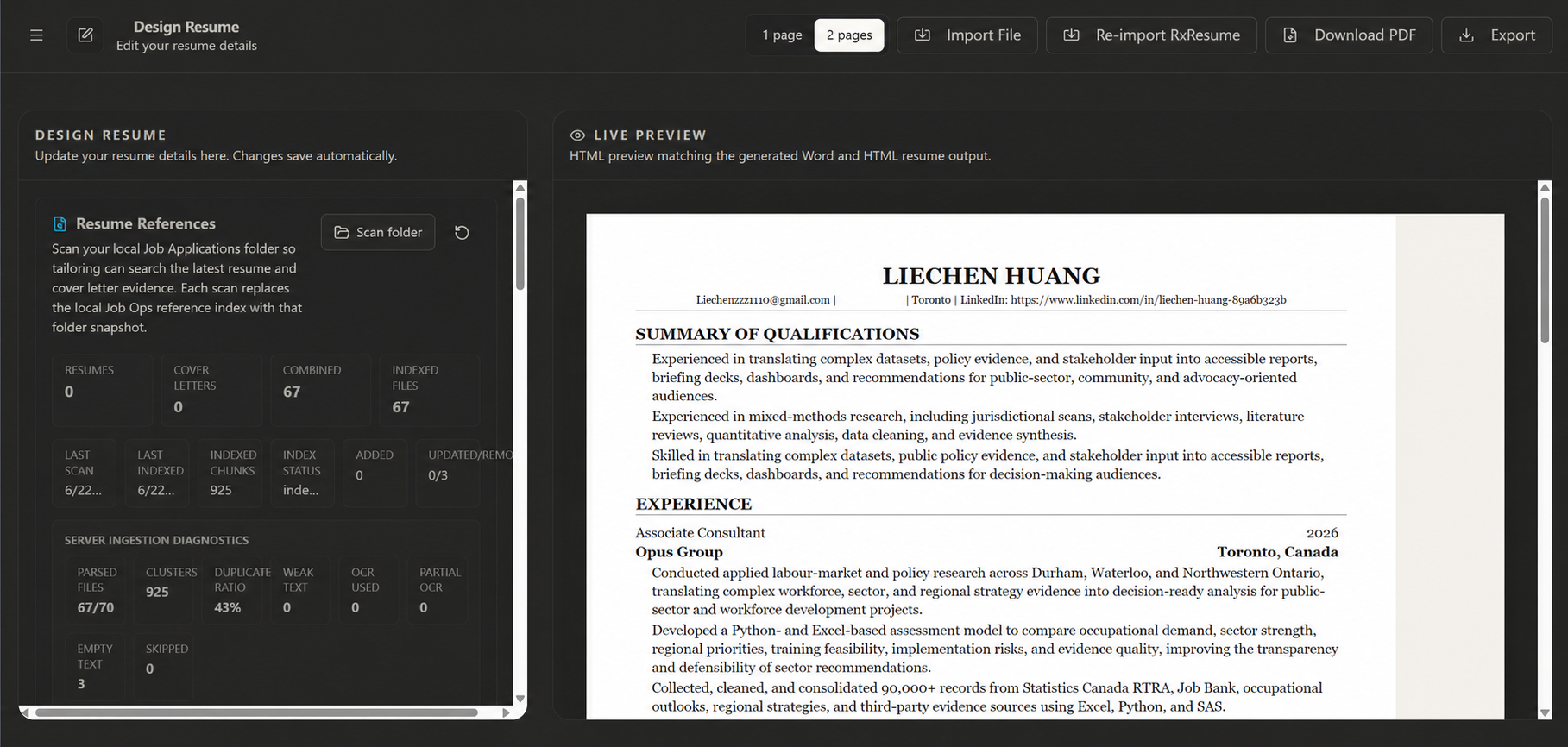
Indexed prior resumes into searchable, section-aware chunks so the system can retrieve relevant past experience before asking AI to write.
Added AI review steps that separate direct support, transferable support, and weak matches before content is drafted into the resume.
Structured generation so resume sections are drafted, checked for alignment and evidence support, then repaired only where issues are found.
What the user gets
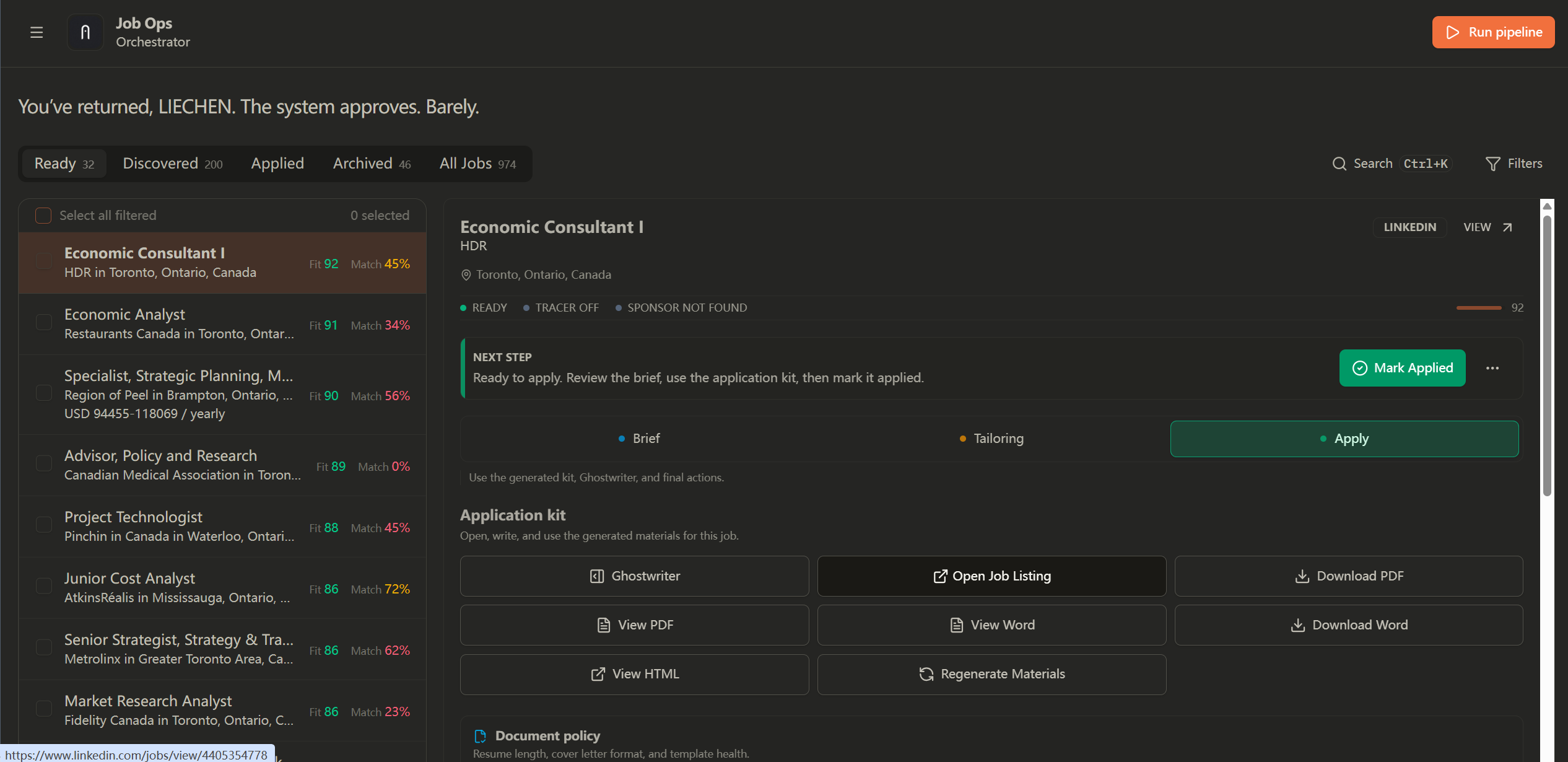
The user provides prior resumes and a target job description; the workflow retrieves relevant experience, proposes a tailored resume, and keeps the final version editable in Word, HTML, and PDF.
Product surfaces
See the evidence going in—and the resume coming out.
Scope
A working AI prototype focused on resume tailoring.
I extended the resume-generation path inside a forked open-source workflow with coordinated AI steps for evidence matching, planning, section generation, review, and repair.
The workflow reduces repetitive tailoring while keeping the user in control. Output quality still depends on the prior resumes, the candidate's actual experience, and final human review.